
How we work
A compliance toll booth for institutional real-world assets.
Money never sits in Unykorn or FTH Trading. Assets live only in bankruptcy-remote Site SPEs. Every capital movement clears a named compliance gate before it happens — and every gate produces a receipt.
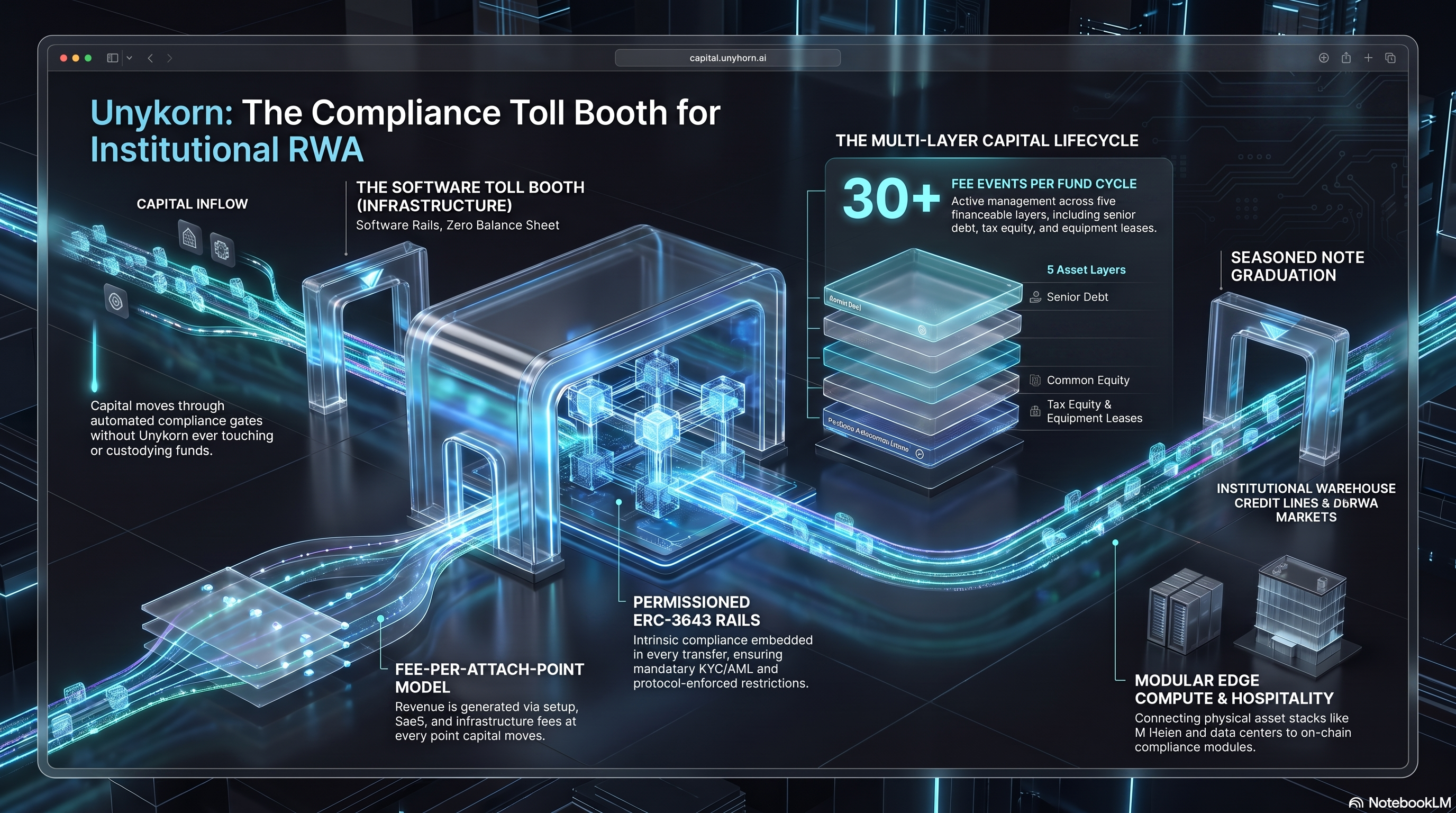
What Unykorn actually is
Unykorn is a non-custodial software gateway for regulated real-world assets. Think of it as Stripe or Visa for institutional RWA — pass-through infrastructure that captures a small fraction of every transaction while never taking custody of the underlying value. What is novel is applying that pattern to the compliance layer where the transactions are securities issuance, distribution, compliance-gated transfer, and attestation-anchored draws.
The four-entity operating stack
Every deal touches four entities, each doing exactly one job:
| Entity | Role | Balance sheet |
|---|---|---|
| Unykorn LLC | Technology rails · compliance infrastructure · non-custodial software gateway | Zero customer funds. Fee revenue only. |
| LD Capital LLC | Issuer of record · Reg D 506(c) offerings · QROF administrator | Sponsor equity + servicing revenue. |
| FTH Trading LLC | Markets operations · LDX secondary book · broker-dealer track | Trading fees + venue economics. |
| Site SPE (per deal) | Bankruptcy-remote borrower · owns the physical asset | The asset itself · debt + equity. |
Assets live only in Site SPEs. Money never sits with the technology or markets entities. Every senior lender interfaces with a clean single-purpose entity, and the technology + markets entities never touch client capital. That separation is the regulatory geometry — it's why the platform can license to N counterparties without accumulating balance-sheet risk.
The six fee mechanisms — how Unykorn earns
Unykorn does not custody assets, hold investor capital, or take transaction-based securities compensation. It operates the compliance and attestation rails through which every dollar flowing across the stack must pass. Each pass triggers a named, deterministic fee.
| # | Mechanism | When it fires | Typical amount |
|---|---|---|---|
| 1 | Setup fee | Once per SPE spin-up. Identity registry wiring, compliance modules, tranche tokens deployed, waterfall priorities configured. | $150k-$300k |
| 2 | SaaS monthly | Every month per live SPE. Registry maintenance, on-chain compliance updates, agent operation, event monitoring. | $10k-$25k / mo |
| 3 | Attestation fee | Per document hash-anchored via ReserveProofAnchor. PPA execution, quarterly hosting revenue, SREC serial minting, gas emissions period record, oracle telemetry. | Basis points via oracle rev-share |
| 4 | Distribution fee | Per on-chain distribution execution — typically quarterly. Basis-point fee on total distributed amount, routed as a named priority in the waterfall. | 5-15 bps of distribution |
| 5 | Issuance basis points | Per primary mint via CustodyAdapter 4-eyes flow. Paid by the SPE at token issuance, not by the investor. Not securities compensation because Unykorn is not selling securities. | 25-75 bps of issuance |
| 6 | License fee | Per external operator using the stack under Master Services Agreement. | Custom · annual + usage |
The scale — thirty-plus fee events per five-site fund cycle
A single QROF fund holding five Site SPEs over its 10-year lifecycle triggers a compound stream of fee events across all six mechanisms — setup at spin-up, monthly SaaS across all five, per-attestation on every meter reading and certificate, per-distribution across quarterly waterfalls, issuance basis points at primary mint. The multiplication effect is deliberate: infrastructure economics, not per-deal economics.
The regulatory geometry — why fees are technology fees
Who we serve
Issuers
Site sponsors and QROF operators who want tokenization + servicing infrastructure without building it in-house. License the rails; keep the deal economics. Setup + monthly SaaS + issuance bps. See Institutional.
Allocators
Family offices, RIAs, and accredited investors seeking exposure to Atlanta and Georgia edge data centers, AI compute infrastructure, QROF opportunity zone equity, and PPA-anchored assets. Access via ERC-3643 tokens.
Senior lenders
Banks and private-credit funds underwriting Site SPE senior debt. Clean bankruptcy-remote borrower, on-chain covenant monitoring, deterministic waterfall — everything a diligence team asks for.
Integration partners
Custodians, KYC providers, EPC contractors, oracle networks — plug into the same standard interfaces. See the Platform capability grid.
External operators
Third-party sponsors licensing the whole machine under Master Services Agreement. Loop Engine model — you bring the deal, we bring the rails.
Regulators & auditors
Every claim on this stack maps to an on-chain attestation and an off-chain legal package. The Trust Center shows how compliance is enforced, and the Legal Entities page verifies the counterparty.
Where we operate
Two Georgia offices, one legal domicile in Wyoming.
| Location | Role |
|---|---|
| Peachtree corridor · Atlanta, GA | Executive office — lakeview presence in Metro Atlanta. Where institutional counterparty meetings and deal execution happen. |
| Alpharetta, GA | Wyoming LLC operations and principal contact address. Registered on all trust surfaces. |
| Wyoming (LLC domicile) | UnyKorn LLC filed July 1, 2026. LEI, EIN, D-U-N-S, ISO MIC all registered under Wyoming. |
The Metro Atlanta presence is deliberate. Atlanta is the Southeast's AI hyperscaler hotspot; the fiber peering fabric (56 Marietta Street, Equinix ATL, Digital Realty ATL) is the deepest in the region; and every Georgia OZ compute site sits within a two-hour drive of the executive office. Deal proximity matters — you can only underwrite what you can visit.
What licensing the stack looks like
External operators sign a Master Services Agreement covering setup, monthly SaaS, per-attestation and per-distribution fee schedules, issuance basis points, service levels, data ownership and portability, and license scope. The MSA is a commercial-services contract — like Stripe, AWS, or Twilio. It is not a securities placement engagement, not a custody agreement, and not a broker-dealer engagement letter.
What we do not do
- We do not custody assets. Qualified custody is delegated to an OCC-chartered trust bank.
- We do not hold investor capital. Subscription funds land in bank / trust escrow only.
- We do not sell securities. LD Capital LLC is the issuer of record for its own Reg D 506(c) offerings; external issuers sell their own paper under their own exemptions.
- We do not take transaction-based securities compensation. Fees are technology-service fees only.
- We do not underwrite deals. Institutional lenders and credit funds do that. We provide the rails; they carry the credit risk.
FeeCollector contract. The four-entity operating stack has verifiable legal entities (see Entities). The waterfall is deterministic CMBSWaterfall.distribute() code. Nothing here is marketing — it is architecture the auditor can inspect line for line.Frequently asked
Is Unykorn a broker-dealer?
No. Unykorn is a non-custodial software gateway. Broker-dealer functions live in FTH Trading, which is on the FINRA BD registration track. LD Capital LLC issues its own paper under Reg D 506(c) exemption without needing a BD for issuer-sold offerings.
How does Unykorn earn if it does not sell securities?
Six named technology-service fees: setup, monthly SaaS, per-attestation, per-distribution, issuance basis points paid by the SPE at primary mint, and license fees for external operators. All are commercial-services fees under standard accounting — not securities compensation.
Why the four-entity separation?
Because senior lenders demand a clean SPE borrower, securities regulators want issuance under a specific exemption with a BD doing only BD things, investors want qualified custody, and the tech operator needs to stay out of balance-sheet risk. The four-entity stack satisfies each of those separately, which is why the platform can license to N counterparties without compounding risk.
Where is Unykorn located?
Two Georgia offices (executive at the Peachtree corridor in Atlanta, and operations in Alpharetta) plus Wyoming LLC domicile. Wyoming for the legal entity (favorable LLC statute, private-registry-friendly); Atlanta for institutional counterparty presence and deal proximity to Southeast AI infrastructure.